One foot while the kettle boils
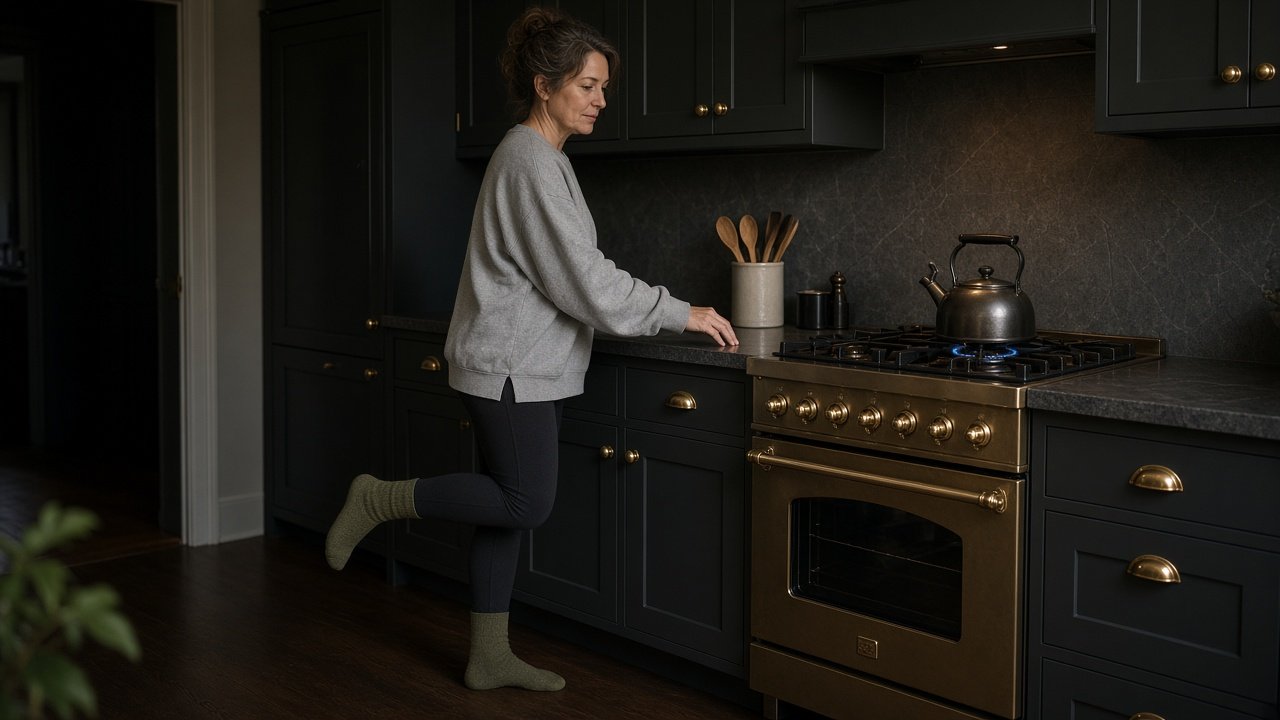
Our kettle takes a little over a minute on the back burner. I know this because I used to leave the kitchen to fold a towel and come back to a scream. Now I stay. While the water works, I stand on one foot. The counter is two inches from my fingers. That is the whole method. No music. No timer besides the kettle, which is a better timer than a phone because it ends itself.
Balance after forty-five is not a circus act. It is the ability to put on a sock without sitting, or to turn in a dark hallway without finding the wall with your shoulder. Standing on one foot in the kitchen is a small, repeatable version of those moments. If you hover a hand over the counter, you have already built the rail into the practice. Use it the instant you need it. Hesitating is how people hop, and hopping is how people meet the stove with a hip.
Start with the foot you like. Most of us have one. Lift the other foot an inch, or rest the toes lightly on the floor if an inch is a lot. Look at something that does not move — the tile grout, the clock, not the bubbling water. The bubbling water is entertainment and it will pull you forward. Thirty seconds on the first foot. Switch. If the kettle is still working, repeat. If it has boiled, you are done. Tea is the reward, not a score.
Shoes off if the floor is dry and not waxed to a shine. Socks on a polished kitchen are ice. I keep a pair of wool socks with a bit of grip for this, the same pair I should not wear on the porch. Bare feet are fine on wood. Bare feet on winter tile can steal the practice away from you with a flinch. Flies are optional. Cats are not coaches; ours sits on the other foot.
What you will notice, if you do this most mornings, is that the standing hip gets tired before the foot does. That is ordinary. Bend the standing knee a hair. Do not lock it back as if you were in a lineup. If the ankle wobbles, that is the work. Wobble is not failure. A wobble you can stay with is practice. A wobble that sends you toward the flame is a cue to put the toes down.
I do not close my eyes. Closing your eyes is a different job, useful in a clinic hallway with a person nearby. In a kitchen with a gas burner, eyes open. If you want a harder version, turn the head slowly toward the window and back, still on one foot, still with the counter in reach. That version mimics looking for a mug. It is more honest than a pose.
My neighbor tries this during microwave minutes. The microwave is a harsher timer; it beeps whether you are ready or not. The kettle at least gives you the sound of water as a warning. Either appliance is better than “I will do it later,” which is how balance practice becomes a January intention and a March apology.
People want to know how long until they “have better balance.” I will not give them a week count. I can tell you that in October I could not reach thirty seconds on the left foot without a finger on the quartz. In January I can, on a good morning, with the cat supervising. That is a kitchen fact. It is not a promise about a future hallway.
What this page will not do is turn the kettle into a program. If you do not drink tea, use the toast. If you do not eat toast, use the time you wait for the weather on the radio. One foot. A rail. Eyes on something still. Then pour.
What you will notice, if you do this most mornings, is that the standing hip gets tired before the foot does.
After the Desk is practice notes, not a store. We do not sell a class, a program, or a product. If a sentence here sounds like a pitch, email help@afterthedesk.com.